Review Test 2 — Homework

Matching Headings (Q14–19) + Matching People (Q20–26)

A In the theatre of the Ambassador Hotel in Los Angeles, on the evening of 27 September 1922, a new form of film-making made its commercial debut: 3-D. The film, The Power of Love, was then shown in New York City to exhibitors and press, but was subsequently not picked up for distribution and is now believed to be lost. The following three decades were a period of quiet experimentation for 3-D pioneers, as they adapted to new technologies and steadily improved the viewing experience. In 1952, the "golden era" of 3-D is considered to have begun with the release of Bwana Devil, and over the next several years audiences met with a string of films that used the technology. Over the following decades it waxed and waned within filmmaking circles, peaking in the 1970s and again in the 1990s when IMAX gained traction, but it is only in the last few years that 3-D appears to have firmly entered mainstream production.

B Released worldwide in December 2009, the fantasy film Avatar quickly became the highest-grossing film ever made, knocking Titanic from the top slot. Avatar, set in 2154 on a planet in a distant solar system, went on to become the only film to have earned US$2 billion world-wide, and is now approaching the $3 billion mark. The main reason for its runaway popularity appears to be its visual splendour; though most critics praised the film, it was mostly on account of its ground-breaking special effects. Kenneth Turan of the Los Angeles Times praised Avatar's "powerful" visual accomplishments, but suggested the dialogue was "flat" and the characterisations "obvious". A film analyst at Exhibitor Relations has agreed, noting that Avatar has cemented the use of 3-D as a production and promotional tool for blockbuster films, rather than as a mere niche or novelty experiment. "This is why all these 3-D venues were built", he said. "This is the one. The behemoth… The holy grail of 3-D has finally arrived".

C Those who embrace 3-D note that it spices up a trip to the cinema by adding a more active "embodied" layer of experience instead of the viewer passively receiving the film through eyes and ears only. A blogger on Animation Ideas writes, "...when 3-D is done well — like in the flying scenes in Up, How to Train Your Dragon and Avatar, there is an added feeling of vertigo. If you have any fear of heights, the 3-D really adds to this element..." Kevin Carr argues that the backlash against 3-D is similar to that which occurred against CGI several years ago, and points out that CGI is now widely regarded as part of the film-maker's artistic toolkit. He also notes that new technology is frequently seen to be a "gimmick" in its early days, pointing out that many commentators slapped the first "talkie" films of the early 1920s with this same label.

D But not everyone greets the rise of 3-D with open arms. Some ophthalmologists point out that 3-D can have unsettling physical effects for many viewers. Dr. Michael Rosenberg, a professor at Northwestern University, has pointed out that many people go through life with minor eye disturbances — a slight muscular imbalance, for example — that does not interrupt day-to-day activities. In the experience of a 3-D movie, however, this problem can be exacerbated through the viewer trying to concentrate on unusual visual phenomena. Dr. Deborah Friedman, from the University of Rochester Medical Center, notes that the perception of depth conjured through three dimensions does not complement the angles from which we take in the world. Eyestrains, headaches and nausea are therefore a problem for around 15% of a 3-D film audience.

E Film critic Roger Ebert warns that 3-D is detrimental to good film-making. Firstly, he argues, the technology is simply unnecessary; 2-D movies are "already" 3-D, as far as our minds are concerned. Adding the extra dimension with technology, instead of letting our minds do the work, can actually be counter-purposeful and make the overall effect seem clumsy and contrived. Ebert also points out that the special glasses dim the effect by soaking up light from the screen, making 3-D films a slightly duller experience than they might otherwise be. Finally, Ebert suggests that 3-D encourages film-makers to undercut drama and narrative in favour of simply piling on more gimmicks and special effects. "Hollywood is racing headlong toward the kiddie market," he says, pointing to Disney's announcement that it will no longer make traditional films in favour of animation, franchises, and superheroes.

F Whether or not 3-D becomes a powerful force for the film-maker's vision and the film-going experience, or goes down in history as an over-hyped, expensive novelty, the technology certainly shows no signs of fading in the popularity stakes at the moment. Clash of the Titans, Alice in Wonderland and How to Train Your Dragon have all recently benefited at the box office due to the added sales that 3-D provides, and with Avatar's record set to last some time as a totem of 3-D's commercial possibilities, studios are not prepared to back down.

The passage has six sections A–F. Choose the correct heading for each section from the list below.

  • i.Construction of special cinemas for 3-D
  • ii.Good returns forecast for immediate future
  • iii.The greatest 3-D film of all time
  • iv.End of traditional movies for children
  • v.Early developments
  • vi.New technology diminishes the art
  • vii.The golden age of movies
  • viii.In defence of 3-D
  • ix.3-D is here to stay
  • x.Undesirable visual effects
14
Section A
Đáp án
V — Early developments
💡 Chi tiết

Đoạn A kể hành trình từ lần ra mắt thương mại năm 1922, qua ba thập kỷ thử nghiệm thầm lặng, rồi đến kỷ nguyên vàng 1952 và sự trỗi dậy trở lại với IMAX những năm 90.
Toàn bộ đoạn mô tả các mốc phát triển ban đầu của công nghệ 3-D heading v 'Early developments' phù hợp nhất.

Keywords paraphrase
Early developments a period of quiet experimentation
15
Section B
Đáp án
Iii — The greatest 3-D film of all time
💡 Chi tiết

Đoạn B tập trung hoàn toàn vào Avatar — phim thu về nhiều tiền nhất từ trước đến nay (highest-grossing), là 'tượng đài' và 'chén thánh (holy grail)' của 3-D heading iii 'The greatest 3-D film of all time' phản ánh đúng.

Keywords paraphrase
The greatest 3-D film of all time the highest-grossing film ever made
16
Section C
Đáp án
Viii — In defence of 3-D
💡 Chi tiết

Đoạn C bảo vệ 3-D: trải nghiệm 'embodied' sống động hơn, cảm giác vertigo khi dùng đúng, và Kevin Carr so sánh phản đối 3-D với phản đối CGI trước đây (cuối cùng được chấp nhận) heading viii 'In defence of 3-D' (bảo vệ 3-D) phù hợp trực tiếp.

Keywords paraphrase
In defence of 3-D Those who embrace 3-D
17
Section D
Đáp án
X — Undesirable visual effects
💡 Chi tiết

Đoạn D liệt kê các tác hại vật lý của 3-D lên thị lực: eyestrains (mỏi mắt), headaches (đau đầu), nausea (buồn nôn) ảnh hưởng đến 15% khán giả heading x 'Undesirable visual effects' (các tác hại thị giác không mong muốn) phù hợp.

Keywords paraphrase
Undesirable visual effects Eyestrains, headaches and nausea
18
Section E
Đáp án
Vi — New technology diminishes the art
💡 Chi tiết

Đoạn E là quan điểm phê bình của Roger Ebert: 3-D không cần thiết (unnecessary), kính đặc biệt làm hình tối đi (duller experience), và khuyến khích phim trường bỏ qua kịch bản/nhân vật để chạy theo kỹ xảo heading vi 'New technology diminishes the art' (công nghệ mới làm giảm giá trị nghệ thuật).

Keywords paraphrase
New technology diminishes the art detrimental to good film-making
19
Section F
Đáp án
Ii — Good returns forecast for immediate future
💡 Chi tiết

Đoạn F kết luận: dù còn nhiều tranh luận, công nghệ 3-D 'shows no signs of fading' (không có dấu hiệu tàn phai), các phim 3-D mới đang thành công tại phòng vé, và các hãng phim không có ý định từ bỏ heading ii 'Good returns forecast for immediate future' (dự báo lợi nhuận tốt trong tương lai gần) phù hợp.

Keywords paraphrase
Good returns forecast studios are not prepared to back down

Match each statement with the correct person A–G. You may use any letter more than once.

  • A — Kenneth Turan
  • B — Exhibitor Relations' analyst
  • C — Animation Ideas' blogger
  • D — Kevin Carr
  • E — Dr. Michael Rosenberg
  • F — Dr. Deborah Friedman
  • G — Roger Ebert
20
3-D conflicts with the mental construct of our surroundings.
Đáp án
F — Dr. Deborah Friedman
💡 Chi tiết

Dr.
Deborah Friedman nói rằng 'the perception of depth conjured through three dimensions does not complement the angles from which we take in the world' — tức 3-D mâu thuẫn với cách não bộ xây dựng không gian trong thực tế (mental construct of our surroundings).

Keywords paraphrase
conflicts with our mental construct does not complement the angles from which we take in the world
21
3-D encourages an overemphasis on quick visual thrills.
Đáp án
G — Roger Ebert
💡 Chi tiết

Roger Ebert cảnh báo 3-D 'encourages film-makers to undercut drama and narrative in favour of simply piling on more gimmicks and special effects' — tức thúc đẩy đạo diễn quá chú trọng vào hiệu ứng hình ảnh (overemphasis on visual thrills) thay vì nội dung.

Keywords paraphrase
overemphasis on quick visual thrills undercut drama and narrative... piling on more gimmicks and special effects
22
Effective use of 3-D technology may increase our sensation of elevation.
Đáp án
C — Animation Ideas' blogger
💡 Chi tiết

Blogger trên Animation Ideas viết 'when 3-D is done well — like in the flying scenes in Up... there is an added feeling of vertigo.
If you have any fear of heights, the 3-D really adds to this element' — tức dùng 3-D hiệu quả có thể tăng cảm giác độ cao (sensation of elevation/vertigo).

Keywords paraphrase
sensation of elevation added feeling of vertigo
23
3-D viewing can worsen an existing visual disorder.
Đáp án
E — Dr. Michael Rosenberg
💡 Chi tiết

Dr.
Michael Rosenberg chỉ ra rằng nhiều người sống với minor eye disturbances (rối loạn thị lực nhỏ) không ảnh hưởng đến sinh hoạt hằng ngày, nhưng 'in the experience of a 3-D movie, however, this problem can be exacerbated' — tức xem 3-D làm tình trạng này tệ hơn (worsen).

Keywords paraphrase
worsen an existing visual disorder minor eye disturbances... can be exacerbated
24
Avatar is the most powerful example of 3-D yet to arrive in cinemas.
Đáp án
B — Exhibitor Relations' analyst
💡 Chi tiết

Nhà phân tích tại Exhibitor Relations gọi Avatar là 'the holy grail of 3-D has finally arrived' — tức đây là ví dụ mạnh nhất (most powerful example), đỉnh cao mà toàn bộ ngành công nghiệp 3-D chờ đợi.

Keywords paraphrase
most powerful example of 3-D the holy grail of 3-D has finally arrived
25
Avatar's strength is found in its visual splendour, not in aspects of story.
Đáp án
A — Kenneth Turan
💡 Chi tiết

Kenneth Turan khen ngợi phần hình ('powerful visual accomplishments') nhưng chê cốt truyện Avatar nhạt ('dialogue was flat and the characterisations obvious') — tức sức mạnh nằm ở visual splendour, không phải story.

Keywords paraphrase
visual splendour powerful visual accomplishments
not in aspects of story dialogue was flat... characterisations obvious
26
People already have the mental capacity to see ordinary movies in three dimensions.
Đáp án
G — Roger Ebert
💡 Chi tiết

Roger Ebert lập luận '2-D movies are already 3-D, as far as our minds are concerned' — tức não người đã có sẵn khả năng (mental capacity) xem phim 2-D như thể 3-D.
Không cần thêm công nghệ.

Keywords paraphrase
mental capacity to see in three dimensions 2-D movies are already 3-D, as far as our minds are concerned
Matching Headings (Q14–18) + Diagram Labels (Q19–22) + Sentence Completion (Q23–26)

A Chinese entrepreneur has figured out a way to manufacture 30-story, earthquake-proof skyscrapers that snap together in just 15 days.

A Zhang Yue is founder and chairman of Broad Sustainable Building (otherwise known as 'Broad') who, on 1 January, 2012, released a time-lapse video of its 30-story achievement. It shows construction workers buzzing around like gnats while a clock in the corner of the screen marks the time. In just 360 hours, a 100-metre-tall tower called the T30 rises from an empty site to overlook Hunan's Xiang River. At the end of the video, the camera spirals around the building overhead as the Broad logo appears on the screen: a lowercase b that wraps around itself in an imitation of the @ symbol. The company is in the process of franchising its technology to partners in India, Brazil, and Russia. What it is selling is the world's first standardized skyscraper and with it, Zhang aims to turn Broad into the McDonald's of the sustainable building industry. When asked why he decided to start a construction company, Zhang replies, 'It's not a construction company. It's a structural revolution.'

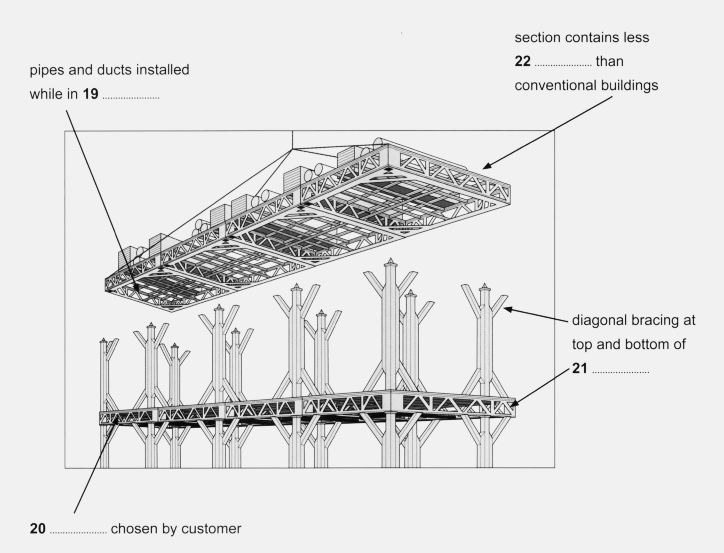
B So far, Broad has built 16 structures in China, plus another in Cancun. They are fabricated at two factories in Hunan, roughly an hour's drive from Broad Town, the sprawling headquarters. The floors and ceilings of the skyscrapers are built in sections, each measuring 15.6 by 3.9 meters with a depth of 45 centimeters. Pipes and ducts for electricity, water and waste are threaded through each floor module while it is still in the factory. The client's choice of flooring is also pre-installed on top. Standardized truckloads carry two modules each to the site with the necessary columns, bolts and tools to connect them stacked on top of each other. Once they arrive at the location, each section is lifted by crane directly to the top of the building, which is assembled like toy Lego bricks. Workers use the materials on the module to quickly connect the pipes and wires. The unique column design has diagonal bracing at each end and tabs that bolt into the floors above and below. In the final step, heavily insulated exterior walls and windows are slotted in by crane. The result is far from pretty but the method is surprisingly safe - and phenomenally fast.

C Zhang attributes his success to his creativity and to his outsider perspective on technology. He started out as an art student in the 1980s, but in 1988, Zhang left the art world to found Broad. The company started out as a maker of non-pressurized boilers. His senior vice-president, Juliet Jiang, says, 'He made his fortune on boilers. He could have kept doing this business, but ... he saw the need for nonelectric air-conditioning.' Towards the end of the decade, China's economy was expanding past the capacity of the nation's electricity grid, she explains. Power shortages were becoming a serious obstacle to growth. Large air-conditioning (AC) units fueled by natural gas could help companies ease their electricity load, reduce overheads, and enjoy more reliable climate control into the bargain. Today, Broad has units operating in more than 70 countries, in some of the largest buildings and airports on the planet.

D For two decades, Zhang's AC business boomed. But a couple of events conspired to change his course. The first was that Zhang became an environmentalist. The second was the earthquake that hit China's Sichuan Province in 2008, causing the collapse of poorly constructed buildings. Initially, he says, he tried to convince developers to refit existing buildings to make them both more stable and more sustainable, but he had little success. So Zhang drafted his own engineers and started researching how to build cheap, environmentally friendly structures that could also withstand an earthquake. Within six months of starting his research, Zhang had given up on traditional methods. He was frustrated by the cost of hiring designers and specialists for each new structure. The best way to cut costs, he decided, was to take the building to the factory. But to create a factory-built skyscraper, Broad had to abandon the principles by which skyscrapers are typically designed. The whole load-bearing structure had to be different. To reduce the overall weight of the building, it used less concrete in the floors; that in turn enabled it to cut down on structural steel.

E Around the world, prefabricated and modular buildings are gaining in popularity. But modular and prefabricated buildings elsewhere are, for the most part, lowrise. Broad is alone in applying these methods to skyscrapers. For Zhang, the environmental savings alone justify the effort. According to Broad's numbers, a traditional high-rise will produce about 3,000 tons of construction waste, while a Broad building will produce only 25 tons. Traditional buildings also require 5,000 tons of water onsite to build, while Broad buildings use none. The building process is also less dangerous. Elevator systems - the base, rails, and machine room - can be installed at the factory, eliminating the risk of injury. And instead of shipping an elevator car to the site in pieces, Broad orders a finished car and drops it into the shaft by crane. In the future, elevator manufacturers are hoping to preinstall the doors, completely eliminating any chance that a worker might fall. 'Traditional construction is chaotic,' he says. 'We took construction and moved it into the factory.' According to Zhang, his buildings will help solve the many problems of the construction industry and what's more, they will be quicker and cheaper to build.
The text has five paragraphs A–E. Choose the correct heading for each paragraph from the list below.

  • i.A joint business project
  • ii.Other engineering achievements
  • iii.Examining the overall benefits
  • iv.A building like no other
  • v.Some benefits of traditional methods
  • vi.A change of direction
  • vii.Examples of similar global brands
  • viii.From factory to building site
14
Paragraph A
Đáp án
Iv — A building like no other
💡 Chi tiết

Đoạn A trình bày tòa nhà T30 độc đáo chưa từng có: 100m chỉ trong 360 giờ, Broad là công ty duy nhất bán skyscraper tiêu chuẩn hoá, Zhang gọi đây là 'a structural revolution' heading iv 'A building like no other' (một tòa nhà không giống bất kỳ tòa nào) phù hợp.

Keywords paraphrase
A building like no other the world's first standardized skyscraper
15
Paragraph B
Đáp án
Viii — From factory to building site
💡 Chi tiết

Đoạn B mô tả toàn bộ quy trình: các module được ráp và lắp ống/dây tại nhà máy (factory), sau đó xe tải chở ra công trường và crane đặt từng section lên (building site) heading viii 'From factory to building site' phù hợp trực tiếp.

Keywords paraphrase
From factory while it is still in the factory
to building site lifted by crane directly to the top of the building
16
Paragraph C
Đáp án
Ii — Other engineering achievements
💡 Chi tiết

Đoạn C không nói về skyscraper mà nói về thành tựu kỹ thuật khác của Zhang: AC units dùng khí tự nhiên giúp giảm tải điện, giảm chi phí, và cải thiện climate control — đây là công trình kỹ thuật ngoài mảng xây dựng heading ii 'Other engineering achievements'.

Keywords paraphrase
Other engineering achievements AC units fueled by natural gas... ease their electricity load, reduce overheads
17
Paragraph D
Đáp án
Vi — A change of direction
💡 Chi tiết

Đoạn D mở đầu bằng 'a couple of events conspired to change his course' — trực tiếp nói về sự thay đổi hướng đi của Zhang từ kinh doanh AC sang nghiên cứu xây dựng heading vi 'A change of direction' phù hợp.

Keywords paraphrase
A change of direction events conspired to change his course
18
Paragraph E
Đáp án
Iii — Examining the overall benefits
💡 Chi tiết

Đoạn E liệt kê toàn bộ lợi ích tổng thể của Broad buildings: ít chất thải xây dựng, không cần nước tại công trình, an toàn hơn (factory installation), và Zhang kết luận rằng công trình của ông sẽ giải quyết nhiều vấn đề của ngành xây dựng heading iii 'Examining the overall benefits'.

Keywords paraphrase
Examining the overall benefits help solve the many problems... quicker and cheaper to build

Label the diagram. Choose ONE WORD ONLY from the text for each answer.

  • Dạng bài: Label the diagram
  • Word limit: ONE WORD ONLY from the text
  • Ghi đúng từ xuất hiện trong bài đọc — không paraphrase
Diagram
19
Pipes and ducts are threaded through each floor module while it is still in the
Đáp án
Factory
💡 Chi tiết
Đoạn B: 'Pipes and ducts for electricity, water and waste are threaded through each floor module while it is still in the factory.' Điểm 19 trong diagram chỉ nơi các ống/dây được lắp = nhà máy (factory).
20
The client's choice of is also pre-installed on top of each floor module
Đáp án
Flooring
💡 Chi tiết
Đoạn B: 'The client's choice of flooring is also pre-installed on top.' Điểm 20 trong diagram chỉ phần sàn nhà (flooring) được lắp sẵn tại nhà máy.
21
The unique design has diagonal bracing at each end and tabs that bolt into the floors above and below
Đáp án
Column
💡 Chi tiết
Đoạn B: 'The unique column design has diagonal bracing at each end and tabs that bolt into the floors above and below.' Điểm 21 trong diagram chỉ phần cột đặc biệt (column) của tòa nhà.
Lưu ý: 'columns' (số nhiều) cũng được chấp nhận.
22
To reduce the overall weight of the building, it used less in the floors
Đáp án
Concrete
💡 Chi tiết
Đoạn D: 'To reduce the overall weight of the building, it used less concrete in the floors; that in turn enabled it to cut down on structural steel.' Điểm 22 trong diagram chỉ vật liệu được giảm bớt = bê tông (concrete).

Complete the sentences. Choose NO MORE THAN TWO WORDS from the text for each answer.

  • Dạng bài: Sentence completion
  • Word limit: NO MORE THAN TWO WORDS from the text
  • Điền từ/cụm từ nguyên văn từ bài đọc — không đổi dạng từ
23
Zhang refers to his business as a
Đáp án
Structural revolution
💡 Chi tiết
Đoạn A: Zhang trả lời khi được hỏi về công ty xây dựng: 'It's not a construction company.
It's a structural revolution.' Zhang gọi doanh nghiệp của mình là 'a structural revolution' (một cuộc cách mạng kết cấu).
24
The first products Broad manufactured were
Đáp án
Boilers
💡 Chi tiết
Đoạn C: 'The company started out as a maker of non-pressurized boilers.' Sản phẩm đầu tiên Broad sản xuất là nồi hơi (boilers).
25
In the late eighties, were holding back industrial progress in China.
Đáp án
Power shortages
💡 Chi tiết

Đoạn C: 'Power shortages were becoming a serious obstacle to growth.' (cuối thập kỷ 80) Thứ kìm hãm tiến bộ công nghiệp tại Trung Quốc là tình trạng thiếu điện (power shortages).

Keywords paraphrase
holding back industrial progress a serious obstacle to growth
26
In addition to power and cost benefits, Broad's AC units improve
Đáp án
Climate control
💡 Chi tiết

Đoạn C: 'Large air-conditioning (AC) units fueled by natural gas could help companies ease their electricity load, reduce overheads, and enjoy more reliable climate control into the bargain.' Ngoài lợi ích về điện (power) và chi phí (cost = overheads), AC units của Broad cải thiện kiểm soát khí hậu (climate control).

Keywords paraphrase
power and cost benefits ease their electricity load, reduce overheads

Listen and complete the missing words.

1
We've removed all (1) from the race path
💡 Chi tiết
Câu nói đầy đủ: 'We've removed all obstacles from the race path.' obstacles = thứ bị dọn đi để đảm bảo đường chạy thông thoáng.
2
medical staff positioned every (2)
💡 Chi tiết
'we have medical staff positioned every two miles' nhân viên y tế đặt mỗi 2 dặm.
3
Please help us (3) the runners
💡 Chi tiết
'Please help us cheer on the runners' cheer on = cổ vũ (phrasal verb).
4
The city centre will be very (4)
💡 Chi tiết
'The city centre will be very congested' congested = tắc nghẽn, đông đúc (tính từ B2).
5
Runners' bags can be (5) the sports centre after the race
💡 Chi tiết
'Runners' bags can be picked up at the sports centre' picked up at = đến lấy tại (phrasal verb 3 từ).
6
If you're worried about being (6) in traffic
💡 Chi tiết
'worried about being held up in traffic' held up = bị kẹt/trì hoãn.
7
please be (7)
💡 Chi tiết
'please be punctual' punctual = đúng giờ (tính từ B2).
8
The race starts at exactly (8)
💡 Chi tiết
'The race starts at exactly 9 AM' chú ý viết đúng format: 9 AM.
9
Don't be (9) the crowd at the start line
💡 Chi tiết
'Don't be put off by the crowd at the start line' put off by = bị nản lòng bởi (phrasal verb).
10
Don't be put off by the (10) at the start line
💡 Chi tiết
'put off by the crowd' crowd = đám đông.
11
There will be (11) water stations this year
💡 Chi tiết
'There will be extra water stations this year' extra = thêm, bổ sung.
12
you'll (12) reach the finish line
💡 Chi tiết
'you'll eventually reach the finish line' eventually = cuối cùng rồi cũng (trạng từ).
13
Remember to (13) at your own pace
💡 Chi tiết
'Remember to set off at your own pace' set off = bắt đầu xuất phát.
14
The route has been slightly (14) from last year
💡 Chi tiết
'The route has been slightly altered from last year' altered = thay đổi (= changed, modified).
15
you'll now run along (15)
💡 Chi tiết
'you'll now run along River Road' đường chạy mới thay cho Park Avenue.
16
we have a festival in (16)
💡 Chi tiết
'we have a festival in Memorial Park' tên địa điểm, viết hoa cả 2 chữ.
17
handmade items like beautiful (17)
💡 Chi tiết
'handmade items like beautiful baskets, jewellery, and craft items' baskets = giỏ xách/rổ thủ công.
18
jewellery, and (18) items
💡 Chi tiết
'jewellery, and craft items' craft items = đồ thủ công mỹ nghệ.
19
we ask that you (19) from the stage area
💡 Chi tiết
'we ask that you keep away from the stage area' keep away from = tránh xa (phrasal verb).
20
a historical display featuring a (20) of the first marathon trophy
💡 Chi tiết
'featuring a replica of the first marathon trophy' replica = bản sao (danh từ B2).
21
the first marathon trophy from (21)
💡 Chi tiết
'the first marathon trophy from 1920' năm 1920.
22
section dedicated to (22)
💡 Chi tiết
'whole section dedicated to children's activities' bao gồm face painting, games, mini fun run.
23
fresh vegetables, (23) , and homemade bread
💡 Chi tiết
'fresh vegetables, herbs, and homemade bread' herbs = rau thơm, thảo mộc.
24
a demonstration on natural (24) for fabrics
💡 Chi tiết
'a demonstration on natural dye for fabrics' dye = thuốc nhuộm (danh từ B2).
Audio nói 'dyes' — cả 'dye' và 'dyes' đều được chấp nhận.
25
at (25)
💡 Chi tiết
'at 3 PM' thời điểm diễn ra demo nhuộm vải.
26
please (26) the marked pathways in the park
💡 Chi tiết
'please keep to the marked pathways in the park' keep to = bám sát/đi theo (phrasal verb).
27
five thousand runners to (27)
💡 Chi tiết
'We expect around five thousand runners to turn up' turn up = xuất hiện, đến tham dự.
28
plus fifteen thousand (28)
💡 Chi tiết
'plus fifteen thousand spectators' spectators = khán giả (danh từ B2).
29
if you find any lost (29)
💡 Chi tiết
'if you find any lost property' lost property = đồ thất lạc (cụm danh từ B2).
30
someone handed in a (30) race number
💡 Chi tiết
'someone handed in a torn race number' torn = bị rách (tính từ B2, past participle của tear).

Listen and complete the missing words.

1
Riverside University was (1) in 1965
💡 Chi tiết
'Riverside University was founded in 1965' founded = được thành lập (past participle, B2).
2
We offer a wide range of (2) across five main faculties
💡 Chi tiết
'a wide range of degree programs across five main faculties' degree programs = các chương trình đào tạo bậc đại học.
3
across five main (3)
💡 Chi tiết
'across five main faculties' faculties = các khoa/trường trong trường đại học.
4
I'll take you on a brief (4)
💡 Chi tiết
'I'll take you on a brief campus tour' campus tour = tham quan khuôn viên trường.
5
to show you our key (5)
💡 Chi tiết
'to show you our key facilities' facilities = cơ sở vật chất.
6
then the science (6)
💡 Chi tiết
'then the science laboratories' laboratories = phòng thí nghiệm.
7
how to (7) a place at Riverside
💡 Chi tiết
'how to apply for a place at Riverside' apply for = nộp đơn xin (phrasal verb).
8
You'll need to (8) your academic transcripts
💡 Chi tiết
'You'll need to submit your academic transcripts' submit = nộp (B2).
9
a personal statement, and two (9)
💡 Chi tiết
'a personal statement, and two references' references = thư giới thiệu.
10
For (10) , we also require proof of English language proficiency
💡 Chi tiết
'For international students, we also require proof of English language proficiency'.
11
proof of English language (11)
💡 Chi tiết
'proof of English language proficiency' proficiency = trình độ thành thạo (B2).
12
regarding (12)
💡 Chi tiết
'regarding tuition fees' tuition fees = học phí.
13
(13) pay higher fees
💡 Chi tiết
'International students pay higher fees' nhắc lại international students trong văn cảnh học phí.
14
which vary by (14) and program
💡 Chi tiết
'which vary by department and program' department = khoa/bộ môn.
15
You can find the exact figures in our (15)
💡 Chi tiết
'You can find the exact figures in our prospectus' prospectus = cẩm nang tuyển sinh của trường (B2).
16
We have several (16) schemes available
💡 Chi tiết
'We have several scholarship schemes available' scholarship = học bổng.
17
To be (17) for most scholarships
💡 Chi tiết
'To be eligible for most scholarships' eligible = đủ điều kiện (B2).
18
demonstrate academic excellence and (18)
💡 Chi tiết
'demonstrate academic excellence and financial need' financial need = khó khăn tài chính.
19
The (19) vary depending on which scholarship
💡 Chi tiết
'The requirements vary depending on which scholarship' requirements = các yêu cầu.
20
based on your grades, (20) require a separate application
💡 Chi tiết
'Some are awarded automatically based on your grades, while others require a separate application'.
21
for all first-year students who (21) by August 1st
💡 Chi tiết
'for all first-year students who enroll by August 1st' enroll = ghi danh nhập học.
22
both catered and (22) halls of residence
💡 Chi tiết
'both catered and self-catered halls of residence' self-catered = tự nấu ăn.
23
All rooms are single (23)
💡 Chi tiết
'All rooms are single occupancy' occupancy = chỗ ở cho một người (B2).
24
Each (24) has dedicated academic advisors
💡 Chi tiết
'Each department has dedicated academic advisors' department lần 2, trong context hỗ trợ học thuật.
25
We also have a (25) service
💡 Chi tiết
'We also have a counselling service' counselling = tư vấn tâm lý (B2).
Cả 2 cách viết counselling/counseling đều được chấp nhận.
26
all free for (26) students
💡 Chi tiết
'all free for registered students' registered = đã ghi danh chính thức.
27
which is heavily (27) by the university
💡 Chi tiết
'which is heavily subsidized by the university' subsidized = được trợ cấp (B2).
Cả subsidised/subsidized đều được.