Trong bài, người hướng dẫn dặn: 'please don't frighten or injure the animals' (đừng làm hoảng sợ hay làm bị thương các con vật).
Đáp án là animal/animals.
Fiddy Working Heritage Farm
Welcome to the Fiddy Working Heritage Farm. This open-air museum gives you the experience of agriculture and rural life in the English countryside at the end of the nineteenth century. So you'll see a typical farm of that period, and like me, all the staff are dressed in clothes of that time.
I must give you some advice and safety tips before we go any further. As it's a working farm, please don't frighten or injure the animals. We have a lot here, and many of them are breeds that are now quite rare.
And do stay at a safe distance from the tools: some of them have sharp points which can be pretty dangerous, so please don't touch them. We don't want any accidents, do we?
The ground is very uneven, and you might slip if you're wearing sandals so I'm glad to see you're all wearing shoes - we always advise people to do that.
Now, children of all ages are very welcome here, and usually even very young children love the ducks and lambs, so do bring them along next time you come.
I don't think any of you have brought dogs with you, but in case you have, I'm afraid they'll have to stay in the car park, unless they're guide dogs. I'm sure you'll understand that they could cause a lot of problems on a farm.
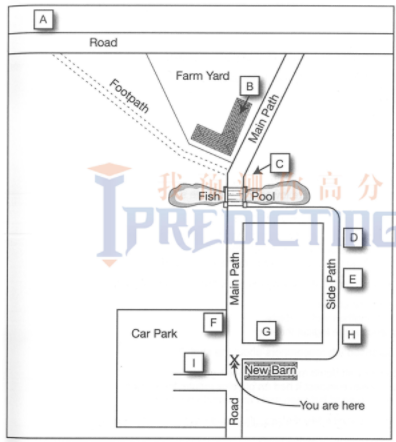
Now let me give you some idea of the layout of the farm. The building where you bought your tickets is the New Barn, immediately to your right, and we're now at the beginning of the main path to the farmland - and of course the car park is on your left. The scarecrow you can see in the car park in the corner, beside the main path, is a traditional figure for keeping the birds away from crops, but our scarecrow is a permanent sculpture.
It's taller than a human being, so you can see it from quite a distance.
If you look ahead of you, you'll see a maze. It's opposite the New Barn, beside the side path that branches off to the right just over there. The maze is made out of hedges which are too tall for young children to see over them, but it's quite small, so you can't get lost in it!
Now, can you see the bridge crossing the fish pool further up the main path? If you want to go to the café, go towards the bridge and turn right just before it. Walk along the side path and the café’s on the first bend you come to.
The building was originally the schoolhouse, and it's well over a hundred years old.
As you may know, we run skills workshops here, where you can learn traditional crafts like woodwork and basket-making. You can see examples of the work, and talk to someone about the courses, in the Black Barn. If you take the side path to the right, here, just by the New Barn, you'll come to the Black Barn just where the path first bends.
Now I mustn't forget to tell you about picnicking, as I can see some of you have brought your lunch with you. You can picnic in the field, though do clear up behind you, of course. Or if you'd prefer a covered picnic area, there's one near the farmyard: just after you cross the bridge, there's a covered picnic spot on the right.
And the last thing to mention is Fiddy House itself. From here you can cross the bridge then walk along the footpath through the field to the left of the farmyard. That goes to the house.
and it'll give you a lovely view of it. It's certainly worth a few photographs, but as it's a private home, I'm afraid you can't go inside.
Right. Well, if you're all ready, we'll set off on our tour of the farm.
Điền MỘT TỪ và/hoặc MỘT SỐ vào mỗi chỗ trống (lời khuyên an toàn).
Chọn chữ cái đúng (A–I) cho mỗi địa điểm. Bấm số trên bản đồ để xem đáp án.

New staff at theatre
Hi. Great to see you! I'm Jody, and I'll be looking after both of you for the first month you're working here at the Amersham Theatre. I'll tell you something about the theatre now, then take you to meet two of the other staff.
It's an old building, and it's been modernised several times. In fact, as you can see, we're carrying out a major refurbishment at the moment. The interior has just been repainted, and we're about to start on the exterior of the building - that'll be a big job.
The work's running over budget, so we've had to postpone installing an elevator. I hope you're happy running up and down stairs! When the theatre was built, people were generally slimmer and shorter than now, and the seats were very close together.
We've replaced them with larger seats. with more legroom. This means fewer seats in total, but we've taken the opportunity to install seats that can easily be moved, to create different acting spaces.
We've also turned a few storerooms over to other purposes, like using them for meetings.
We try hard to involve members of the public in the theatre. One way is by organising backstage tours, so people can be shown round the building and learn how a theatre operates. These are proving very popular.
What we're finding is that people want to have lunch or a cup of coffee while they're here, so we're looking into the possibility of opening a café in due course. We have a bookshop, which specialises in books about drama, and that attracts plenty of customers. Then there are two large rooms that will be decorated next month, and they'll be available for hire, for conferences and private functions, such as parties.
We're also considering hiring out costumes to amateur drama clubs.
Now I want to tell you about our workshops. We recently started a programme of workshops that anyone can join. Eventually we intend to run courses in acting, but we're waiting until we've got the right people in place as trainers.
That's proving more difficult than we'd expected! There's a big demand to learn about the technical side of putting on a production, and our lighting workshop has already started, with great success. We're going to start one on sound next month.
A number of people have enquired about workshops on make-up, and that's something we're considering for the future. A surprise success is the workshop on making puppets - we happen to have someone working here who does it as a hobby, and she offered to run a workshop. It was so popular we're now running them every month!
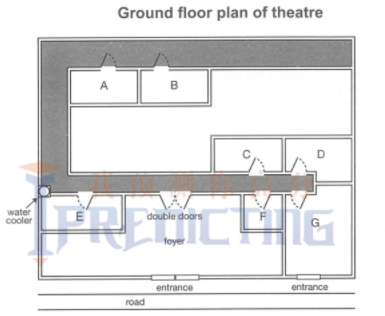
Now, a word about the layout of the building. The auditorium, stage and dressing rooms for the actors are all below ground level. Here on the ground floor we have most of the rooms that the public doesn't see. The majority are internal, so they have windows in the roof to light them.
Standing here in the foyer, you're probably wondering why the box office isn't here, where the public would expect to find it. Well, you might have noticed it on your way in- although it's part of this building, it's next door, with a separate entrance from the road.
For the theatre manager's office, you go across the foyer and through the double doors, turn right, and it's the room at the end of the corridor, with the door on the left.
The lighting box is where the computerised stage lighting is operated, and it's at the back of the building. When you're through the double doors, turn left, turn right at the water cooler. and right again at the end.
It's the second room along that corridor. The lighting box has a window into the auditorium, which of course is below us.
The artistic director's office is through the double doors, turn right, and it's the first room you come to on the right-hand side. And finally, for the moment, the room where I'll take you next -the relaxation room. So if you'd like to come with me...
Chọn HAI đáp án đúng (thứ tự không tính).
Chọn chữ cái đúng (A–G) cho mỗi phòng. Bấm số trên bản đồ để xem đáp án.

1 Good morning, and welcome to the museum - one with a remarkable range of exhibits, which I'm sure you'll enjoy. My name's Greg, and I'll tell you about the various collections as we go round. But before we go, let me just give you a taste of what we have here.
2 Well, for one thing, we have a fine collection of twentieth and twenty-first century paintings, many by very well-known artists. I'm sure you'll recognise several of the paintings. This is the gallery that attracts the largest number of visitors, so it's best to go in early in the day, before the crowds arrive.
3 Then there are the nineteenth-century paintings. The museum was opened in the middle of that century, and several of the artists each donated one work - to get the museum started, as it were. So they're of special interest to us - we feel closer to them than to other works.
4 The sculpture gallery has a number of fine exhibits, but I'm afraid it's currently closed for refurbishment. You'll need to come back next year to see it properly, but a number of the sculptures have been moved to other parts of the museum.
5 "Around the world' is a temporary exhibition-you've probably seen something about it on TV. or in the newspapers. It's created a great deal of interest, because it presents objects from every continent and many countries, and provides information about their social context- why they were made, who for, and so on.
6 Then there's the collection of coins. This is what you might call a focused, specialist collection, because all the coins come from this country, and were produced between two
7 thousand and a thousand years ago And many of them were discovered by ordinary people digging their gardens, and donated to the museum!
8 All our porcelain and glass was left to the museum by its founder when he died in 1878. And in the terms of his will, we're not allowed to add anything to that collection: he believed it was perfect in itself, and we don't see any reason to disagree!
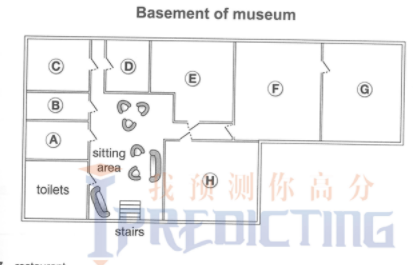
9 OK, that was something about the collections, and now here's some more practical information, in case you need it. Most of the museum facilities are downstairs, in the basement, so you go down the stairs here. When you reach the bottom of the stairs, you'll find yourself in a sitting area, with comfortable chairs and sofas where you can have a rest before continuing your exploration of the museum.
10 We have a very good restaurant, which serves excellent food all day, in a relaxing atmosphere. To reach it, when you get to the bottom of the stairs, go straight ahead to the far. side of the sitting area, then turn right into the corridor. You'll see the door of the restaurant facing you.
11 If you just want a snack, or if you'd like to eat somewhere with facilities for children, we also have a café. When you reach the bottom of the stairs, you'll need to go straight ahead, turn right into the corridor, and the café is immediately on the right.
12 And talking about children, there are baby-changing facilities downstairs: cross the sitting area, continue straight ahead along the corridor on the left, and you and your baby will find. the facilities on the left-hand side.
13 The cloakroom, where you should leave coats, umbrellas and any large bags, is on the left hand side of the sitting area. It's through the last door before you come to the corridor.
14 There are toilets on every floor, but in the basement they're the first rooms on the left when you get down there.
15 OK, now if you've got anything to leave in the cloakroom, please do that now, and then we'll start our tour.
What does the speaker say about each collection? Chọn SÁU đáp án từ khung (A–G).
Chọn chữ cái đúng (A–H) cho mỗi khu. Bấm số trên bản đồ để xem đáp án.